e

Roman edifices

Verona is famous for its Roman amphitheatre, the Arena found in the city's largest piazza, the Piazza Bra. Completed around 30 AD, it is the third largest in Italy after Rome's Colosseum and the arena at Capua. It measures 139 metres long and 110 metres wide, and could seat some 25,000 spectators in its 44 tiers of marble seats. The ludi (shows and gladiator games) performed within its walls were so famous that they attracted spectators from far beyond the city. The current two-story façade is actually the internal support for the tiers; only a fragment of the original outer perimeter wall in white and pink limestone from Valpolicella, with three stories remains.The interior is very impressive and is virtually intact, and has remained in use even today for public events, fairs, theatre and open-aired opera during warm summer nights.
Verona Arena
Porta Leoni is the 1st century BC ruin of what was once part of the Roman city gate. A substantial portion is still standing as part of the wall of a medieval building. The street itself is an openarchaeological site, and the remains of the original Roman street and gateway foundations can be seen a few feet below the present street level. As can be seen from there, the gate contains a small court guarded by towers. Here, carriages and travelers were inspected before entering or leaving the city.Nearby is the Porta Borsari, an archway at the end of Corso Porta Borsari. This is the façade of a 3rd-century gate in the original Roman city walls. The inscription is dated 245 AD and gives the city name as Colonia Verona Augusta. Corso Porta Borsari, the road passing through the gate is the original Via Sacra of the Roman city. Today, it is lined with several Renaissance palazzi and the ancient Church of SS. Apostoli (left), a few metres from Piazza delle Erbe.


Piazza dei Signori


Medieval architecture

Share:

Lion de Belfort

  statue or sculpture of Frederic Bartholdi who designed the Statue of Liberty that lies off the coast of Americaa New York City, it is located in the city of Belfort in eastern France near the slot between the Vosges Mountains and the Jura.It was completed in 1880 and fully made of red sandstone, has been making its parts individually and then re-assembled under the old castle town, with a length of 22 meters and a height of 11 meters. And based on his back to the Rock of the city.Captures the lion's courage and bravery Balfour and her family during the attack, which lasted 103 days by Prussia (from December 1870 to February 1871), where the protection of the city population (17,000 people all of whom 3,500 were military) led Dunfar Roshroo Colonel who was urging the steadfastness of nearly 40,000 Prussian troops Ghazi.There peer bronze miniature of the lion in "Dunfar Roshroo Square" in Paris, where it seems like watching the Parisian traffic, as well as another version at the Botanical Garden in Montreal, Canada.


Share:

AREVA Tour

Is a skyscraper office is located in the business district of La Défense, the business district is a high-rise buildings, in the town of Courbevoie, west of Paris, France.

Built in 1974, the length of 184 meters when completed, the second tallest tower in La Défense and the third tallest tower in the Ile-de-France. Tour Areva completely black, and consists of black-fronted windows and dark granite. Full prism shape is square. It is said that architects design the tower inspires black monolith in the movie "2001: A Space Odyssey" to Stanley Kubrick presented in 1968.

The site where the children of Tour Areva download codenamed CB1 in the initial outline of the central area La Defense. It was initially planned to build a twin tower to tower to Areva in the current location of the tower's Total, but was canceled because of the oil crisis of 1974.

In 1987 the French authorities granted to Patrick Galardon license free to jump from the top of Tour Areva and this decision has been interesting because this is very rare in French urban areas.
Share:

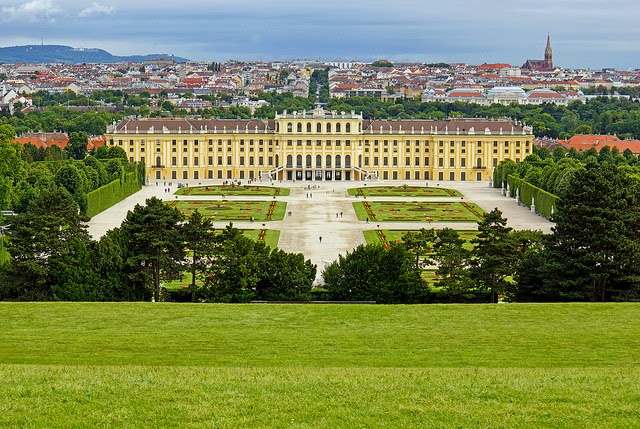
Vienna


is the capital and largest city of Austria, and one of the nine states of Austria. Vienna is Austria's primary city, with a population of about 1.794 million[5] (2.6 million within the metropolitan area,[4]more than 20% of Austria's population), and its cultural, economic, and political centre. It is the 7th-largest city by population within city limits in the European Union. Until the beginning of the 20th century it was the largest German-speaking city in the world, and before the splitting of the Austro-Hungarian Empire in World War I the city had 2 million inhabitants.[6] Today it is the second only to Berlin in German speakers.[7][8] Vienna is host to many major international organizations, including the United Nations and OPEC. The city lies in the east of Austria and is close to the borders of the Czech Republic, Slovakia, andHungary. These regions work together in a European Centrope border region. Along with nearby Bratislava, Vienna forms a metropolitan region with 3 million inhabitants. In 2001, the city centre was designated a UNESCO World Heritage Site.[9]
Share:

National Stadium in Warsaw


National Stadium in Poland is a football stadium in the Polish city of Warsaw, was built on the former site Stadium main city, and funded by the Polish government in its entirety.

And expanding the stadium 58 145 spectators, construction started in 2008 and was its completion in June 2010, has hosted the opening match of the European Nations Cup Football 2012 matches matches the group, in addition to the match of the quarter-final and semi-final, Cup hosted by Poland jointly with its neighbor Ukraine.

Although this stadium is not officially registered for a club capital Warsaw for both club (Liga Warsaw) or rivals (Warsaw, Poland), the two clubs were able to use the stadium for the most important their matches.

Besides the green rectangle has been building the track inner athlete with plenty of 15,000 spectators, a swimming pool Olympian with a capacity of 4,000 spectators, a water park and a hotel and conference center, restaurants and service facilities, was the second phase after the construction of the stadium is the railway near the stadium and the opening of the station for trains to renew spending near the stadium and linked with spending lines in the city center. This project is funded by the government and the Government of Poland and not the Warsaw city or his municipality is the main financier.
Share: